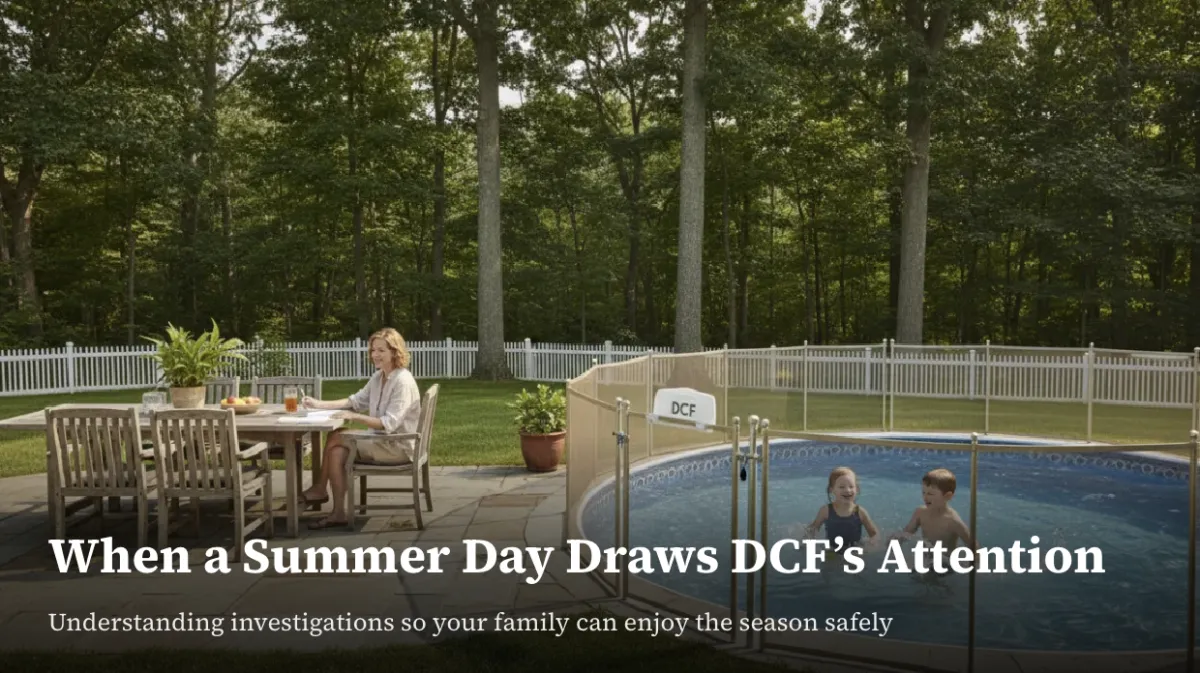
Connecticut DCF: Summer Safety & Family Law Insights
Family Law, Connecticut DCF, Summer Safety
How an Ordinary Summer Day Can Turn Into a DCF Investigation: A Hypothetical Story from a Former Investigator
This story is hypothetical and for educational purposes only. It does not create an attorney–client relationship, and it is not legal advice. Every family’s situation is different; if you have questions about your own case, you should speak directly with an attorney familiar with Connecticut DCF matters.
A Summer Saturday in Connecticut: Nicole’s Perspective
My name is Nicole Christie. Before I became a defense attorney, I worked for years as an investigator with the Connecticut Department of Children and Families (DCF). I spent many hot, humid summers driving from home to home, trying to answer one core question: Are these children safe?
To help you understand what a Summer DCF investigation can look like, I want to walk you through a fictional day in the life of one family. The people and events are made up, but the process, the emotions, and the decisions reflect what I saw again and again in real cases. As you read, notice how ordinary choices, reasonable mistakes, and even misunderstandings can draw DCF’s attention—especially when the weather is warm and kids are home more often.
9:00 a.m. – A Busy Summer Morning Begins
It’s a July Saturday in Hartford County. The fictional mom in our story, Maria, is getting her three children—ages 4, 7, and 10—ready for a day at home. Her sister is coming over for a cookout. The kids are excited about the small pool in the backyard and the sprinkler on the lawn. Like many parents, Maria is trying to juggle everything: laundry, food, texts from work, and a house that suddenly feels too small for three energetic kids on summer break.
She does a few things right away that matter more than she realizes:
She checks that the pool gate is latched and the ladder is pulled up when no adult is outside.
She reminds the kids, “No one goes near the pool without an adult.”
She keeps her cell phone charged and a list of emergency contacts—including their pediatrician and a nearby neighbor—on the fridge.
These are the kinds of reasonable summer safety precautions that DCF investigators look for later. No parent can prevent every scrape or argument, but planning ahead shows that you are thinking about your children’s safety in a realistic way.
11:15 a.m. – A Scare by the Pool and a Concerned Neighbor
By late morning, the sun is high and the kids are begging to swim. Maria’s sister, Elena, arrives, and the two adults sit on the deck with iced tea while the kids splash in the pool. They are watching, but not constantly hovering. The 10-year-old can swim well; the 7-year-old is learning; the 4-year-old wears a life vest and stays close to the steps.
At one point, Maria goes inside to grab more towels. She calls out, “Elena, keep an eye on them, I’ll be right back.” Elena nods, but her attention drifts to her phone. In those few minutes, the 4-year-old slips on the wet deck, bumps his head, and starts crying loudly. He is scared more than seriously hurt, but the noise carries over the fence to a neighbor who cannot see the whole scene—only a crying child near water and adults who seem distracted.
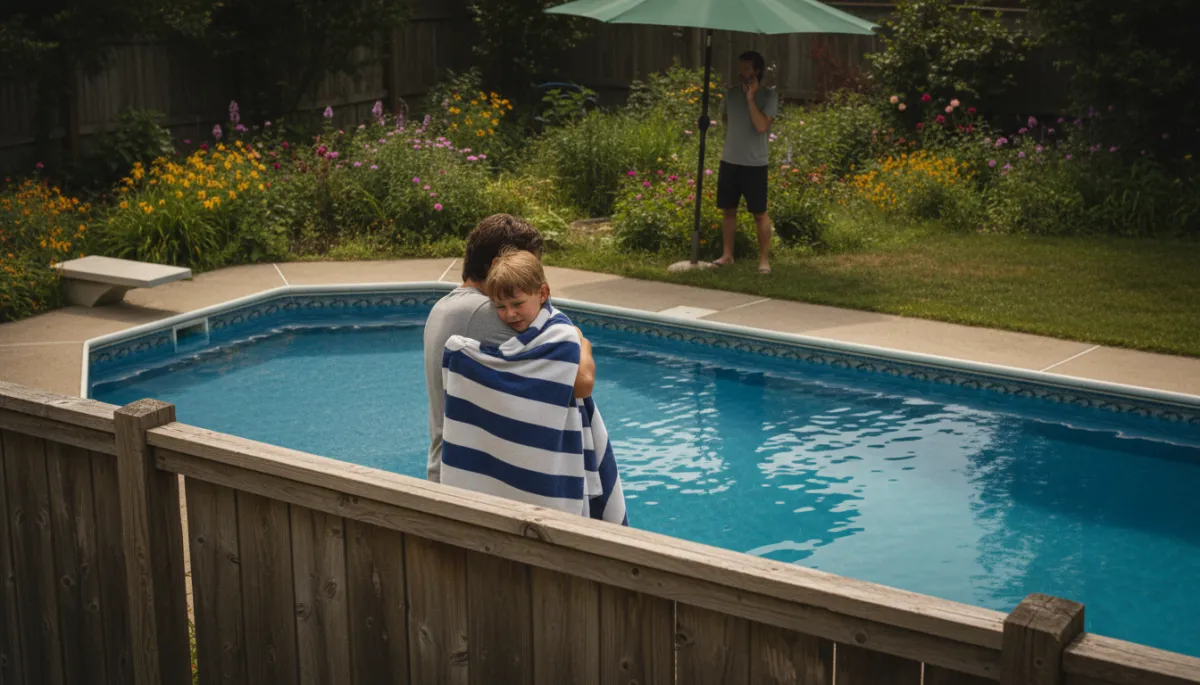
Partial views and assumptions often shape the reports that reach DCF.
The neighbor, who we will call Mr. Lewis, has heard stories about drownings and neglect. He worries that the child is unsupervised. He does not know that Maria and Elena have been taking turns watching the kids, or that the 4-year-old is wearing a life vest. From his limited view, it looks dangerous. His concern is genuine, even if his information is incomplete.
11:45 a.m. – How a Summer DCF Report Is Made
After pacing for a while, Mr. Lewis decides to call the DCF Careline. This is how many reports are made during the summer: a neighbor, a passerby, a lifeguard, or a camp counselor sees something that worries them and contacts the state. Some reporters are mandated reporters—such as teachers, doctors, and childcare workers—who are legally required to report suspected abuse or neglect. Others, like Mr. Lewis, are concerned community members making a voluntary report.
On the phone, the Careline worker asks Mr. Lewis a series of questions:
What did you see and hear?
How old do you think the children are?
Do you know the family? Have you seen other concerning situations?
Is there an immediate danger, such as a child alone near water or a roadway?
Mr. Lewis explains that he heard a child crying near the pool, saw adults “on their phones,” and has occasionally heard shouting from the yard on other days. Based on the information he provides, the Careline worker decides this meets the threshold for a neglect report. The call is documented and sent to the local DCF office for screening.
Early Afternoon – The Investigation Is Assigned
This is where my former role comes in. As a DCF investigator, I would receive a summary of the report: “Allegation of inadequate supervision around pool. Multiple children. Neighbor reports frequent yelling. Possible risk of physical neglect.” From there, the office decides whether to screen in the case for investigation or screen it out as not meeting statutory criteria.
During the summer, when children are out of school and around water, grills, and outdoor equipment, DCF often takes pool-related reports seriously. In our hypothetical, the case is screened in, and I am assigned to make a same-day visit to assess safety. The goal is not to punish parents for every mistake but to determine whether there is an ongoing risk that needs intervention.
3:00 p.m. – The Knock on the Door
Imagine Maria’s surprise when I arrive at her door, identification badge visible, and introduce myself as an investigator with the Connecticut Department of Children and Families. The children are inside now, watching a movie and eating popsicles. The pool gate is closed. The 4-year-old has a small bump on his forehead but is laughing with his siblings.
I explain, calmly, that DCF received a report and that I need to ask some questions and see the home. This is often the most frightening moment for parents. They imagine the worst. But from the investigator’s side, I am asking myself a structured set of questions: What is really happening here? Are the children safe today? What about tomorrow?
What Investigators Evaluate During a Summer DCF Visit
During a home visit like this, investigators evaluate far more than one brief incident. We look at context and patterns, not just a single moment someone happened to witness. In a summer case involving pools and outdoor play, I would pay attention to:
Supervision practices: Who watches the children outside? Are adults within sight and sound? Do they understand the risks of water, heat, and outdoor equipment?
Physical safety measures: Is there a secure fence or locked gate around the pool? Are grills, fire pits, tools, and chemicals stored safely out of children’s reach?
Injury response: When the 4-year-old fell, did the adults respond quickly? Did they check for signs of a serious head injury? Do they know when to call 911 or the pediatrician?
Overall home environment: Is the home reasonably clean and organized? Are there obvious hazards, such as exposed wires, unlocked firearms, or dangerous clutter?
Parent insight and willingness to adjust: Do the caregivers understand the concern? Are they open to improving safety, or do they deny any risk exists?
In Maria’s case, I see safety signs everywhere: the posted “Pool Rules” on the back door, the life vests hanging neatly, the ladder pulled up when the kids are not swimming, the list of emergency contacts on the refrigerator. She describes how she and her sister alternate watching the kids, and she acknowledges that stepping inside while her sister looked at her phone was “not ideal” and that they will be more careful going forward.
Why Context and Reasonable Safety Precautions Matter
This is where my experience as both a former investigator and a defense attorney shapes how I view these situations. Context matters. No family can provide perfect supervision every second. Children fall. They argue. They test boundaries. The question is not whether something bad ever happens—it is whether the caregivers are reasonably prepared and willing to correct problems.
When investigators see that parents have taken practical summer safety steps, it often weighs heavily in their favor. These include:
Supervising children near pools and water at all times, even if they can swim. Designating a “water watcher” adult who is not on their phone or drinking alcohol while kids are in or near the water.
Securing hazardous areas, such as pools, decks, sheds, and garages, with locks, gates, or childproof latches. Keeping chemicals, tools, and grills out of children’s reach when not in use.
Preparing emergency contacts and plans: knowing who to call, where the nearest urgent care is, and who can help in a crisis if the primary caregiver becomes unavailable.
These actions do not guarantee that DCF will never knock on your door, but they show that you take your role seriously. As an attorney now, I often highlight these efforts when defending parents in DCF matters, because they demonstrate responsible parenting, not neglect.
The Outcome of Our Hypothetical Summer Investigation
Back in our story, I finish interviewing Maria, briefly speak with the children in an age-appropriate way, and walk through the yard and home. I document what I see: safety measures in place, attentive caregivers, children who appear bonded and comfortable. I also document the fall by the pool and the parents’ acknowledgment that they can tighten supervision when adults are distracted.
After reviewing everything with my supervisor, this hypothetical case is closed without a finding of neglect. We might offer optional resources—like parenting classes or water safety information—but we do not remove the children or keep the case open unnecessarily. The initial report was based on a limited snapshot; the full picture showed a family that was generally safe, caring, and willing to improve.
Every Situation Is Unique – But Knowledge Brings Confidence
While this story is fictional, the emotions it reflects—fear, confusion, frustration—are very real for families who face a Summer DCF investigation. Some cases are more serious than Maria’s. Others are even more clearly unfounded. Every situation is unique. The facts of your family, your history, your children’s needs, and your safety planning all matter deeply in how DCF views your case and what options you have to respond.
What I want parents to understand is this: knowing the process can reduce fear. When you understand how reports are made, what investigators evaluate, and why context and reasonable safety precautions matter, you can make informed choices. You can also recognize when you need legal guidance and when a situation may be resolved with better communication and planning.
📌 Key Takeaway: You cannot control every neighbor’s opinion or every scraped knee, but you can control your safety planning, your documentation, and how you respond if DCF contacts you.
Enjoying Summer with Confidence – And Knowing Where to Turn for Help
Summer should be a time of sprinklers, cookouts, and late sunsets—not constant fear of an investigation. By supervising children near pools, securing hazardous areas like decks, sheds, and grills, and preparing emergency contacts and plans, you give your family a strong foundation for safety. If DCF ever does show up at your door, these steps can also help show that you are a responsible, caring parent doing your best under real-world conditions.
Understanding the Connecticut Department of Children and Families’ process does not remove all anxiety, but it can help you enjoy summer with more confidence. You are not powerless. You can prepare, ask questions, and, when necessary, get professional support to protect both your children and your rights.
Need Guidance? The Christie Law Firm and the Fight DCF Course Can Help
If you are facing a DCF investigation—whether it started with a summer pool incident, a misunderstanding at camp, or a report from a neighbor—you do not have to navigate it alone. As a former Connecticut DCF investigator turned defense attorney, I built The Christie Law Firm to help parents understand the system, assert their rights, and protect their families.
For parents who want to go even deeper, the Fight DCF Course offers structured, step-by-step education about the DCF process, your options, and how to respond strategically at every stage. It is designed to turn fear into knowledge and confusion into a clear plan of action.
Remember, this story is hypothetical and for educational purposes only, but the stakes in real life are very real. If DCF has contacted you, or if you simply want to be prepared, I invite you to reach out to The Christie Law Firm to discuss your situation, or explore the Fight DCF Course to better understand your rights and options.
With the right information and support, you can protect your children, respond confidently to any investigation, and still give your family the joyful, memorable summer you all deserve.
