Understanding School Reports to DCF Connecticut
Family Law, DCF Investigation, Tell-It Thursday
Tell-It Thursday: Understanding a School Report to DCF Connecticut
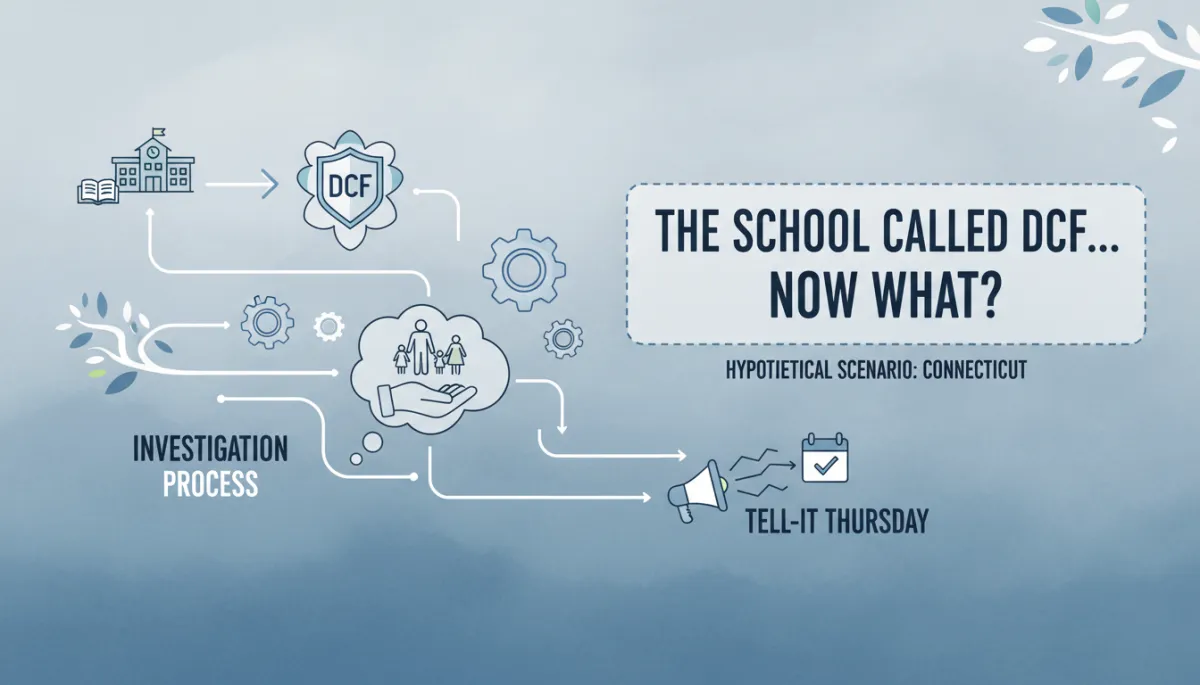
In this Tell-It Thursday blog, we walk through a clearly labeled Hypothetical Scenario—“The School Called DCF... Now What?”—to demystify how a DCF Investigation begins and what families in Connecticut can realistically expect when a school makes a report to the Department of Children and Families (DCF).
What Is Tell-It Thursday?
Tell-It Thursday is a recurring, educational series designed to take intimidating legal and child-welfare topics and make them more understandable for everyday families. By using stories, plain language, and Hypothetical Scenarios, we aim to answer the questions parents are often too stressed or scared to ask out loud. Today’s Tell-it Thursday focuses on what happens when a school report to DCF Connecticut triggers a formal DCF Investigation.
Why Schools Call DCF in Connecticut
In Connecticut, teachers, school counselors, nurses, administrators, and many other school staff are considered mandated reporters. That means the law requires them to make a report to DCF if they reasonably suspect a child may be abused, neglected, or at risk of serious harm. They do not have to be certain. They do not have to conduct their own full investigation. Their role is to notice red flags and pass those concerns to DCF so professionals trained in child protection can look more closely.
For parents, this can feel deeply personal and even like a betrayal. But it is important to understand that when a school makes a report, they are following state law, not “taking sides.” Recognizing this context is the first step in navigating a DCF Investigation with a clear head rather than pure panic.
Hypothetical Scenario: “The School Called DCF... Now What?”
To bring the process to life, this Tell-It Thursday centers on a Hypothetical Scenario. Names, details, and facts are fictional, but the sequence of events mirrors what many Connecticut families experience once a school report to DCF Connecticut has been filed.
Step 1: The School’s Concern
Imagine a seventh-grade student, “Alex,” who has recently become withdrawn, is frequently tired, and has shown up to school several times wearing the same clothes. One day, Alex confides in the school counselor that there is a lot of yelling at home, that food sometimes “runs out,” and that Alex is afraid to “make Mom mad.” The counselor documents the conversation and, as a mandated reporter, decides a call to DCF is necessary.
📌 Key Takeaway: A report is based on concern, not proof. The school’s role is to notify, not to judge or decide the outcome of a DCF Investigation.
Step 2: The Call to the DCF Careline
The counselor calls the DCF Careline and provides details: Alex’s statements, observations of clothing and hygiene, attendance patterns, and any previous concerns. This is the formal school report to DCF Connecticut. The Careline worker asks clarifying questions, enters the information into their system, and decides whether the report meets the criteria to be “accepted” for a DCF Investigation.
In our hypothetical, the report is accepted. The allegations are coded as potential neglect due to concerns about supervision, emotional climate in the home, and possible lack of basic needs like food and clothing.
Step 3: The First Contact with the Family
A DCF social worker is assigned and reaches out to Alex’s mother, Ms. Rivera. The call may come quickly—sometimes the same day, sometimes within a few days. The worker introduces themselves, explains that a report was made, and asks to schedule a home visit. For many parents, this is the most frightening moment. They may not know exactly what was reported or by whom, and they may fear that their child will be taken away immediately.
💡 Pro Tip: During Tell-It Thursday conversations, we encourage parents to stay calm, take notes, and ask the worker to repeat or clarify anything they do not understand about the investigation process.
Inside the DCF Investigation Process
Once a report is accepted, the DCF Investigation follows a relatively structured path, though the details can vary by family and situation. Understanding the typical steps can remove some of the fear of the unknown.
Safety Assessment: DCF first considers whether there is any immediate danger to the child. In urgent situations, action can be taken quickly, but in many cases, the focus is on support and assessment, not removal.
Interviews: The social worker may talk with the child, parents or caregivers, siblings, and sometimes extended family or other adults involved in the child’s life, such as teachers or therapists.
Home Visit: The worker typically visits the home to see the living environment, check for basic safety, and observe family interactions.
Documentation Review: School records, medical records, or previous DCF involvement may be reviewed to build a fuller picture of the child’s situation.

Many DCF investigations focus on assessing needs and connecting families with support services.
How This Plays Out in Our Hypothetical Scenario
In “The School Called DCF... Now What?”, the social worker visits Ms. Rivera’s apartment. The home is small but clean. The refrigerator is not empty, but food is limited toward the end of the month. Ms. Rivera explains she is a single parent working two jobs and that transportation issues have affected Alex’s attendance. She acknowledges yelling when she is stressed but denies physical discipline or intentional neglect.
The worker also meets privately with Alex, who shares feeling scared when arguments get loud and embarrassed about wearing the same clothes. Alex confirms that there is food, but sometimes it feels like “not enough” and that Mom is “really tired all the time.” These details help DCF understand that the core issues may be poverty, stress, and lack of support rather than intentional harm.
Possible Outcomes of a DCF Investigation
At the conclusion of the investigation process, DCF makes findings and decides what, if anything, needs to happen next. In Connecticut, outcomes can include:
No further action: DCF determines that the allegations are unsubstantiated and the case is closed, sometimes with referrals to optional community resources.
Services and supports: The family may be offered or required to engage in services such as parenting classes, counseling, in-home support, or financial assistance programs.
Ongoing DCF involvement: In more serious cases, DCF may open a case for continued monitoring, develop a safety plan, or, in rare situations, seek court intervention to ensure the child’s safety.
In our Tell-It Thursday Hypothetical Scenario, DCF concludes that Alex is not in immediate danger but that the family is under significant stress. The case is opened for voluntary services: help with budgeting, access to food programs, and counseling for both Alex and Ms. Rivera to improve communication and reduce conflict in the home.
How Parents Can Navigate a School-Initiated DCF Investigation
Being the subject of a DCF Investigation after a school report can feel overwhelming, but there are constructive steps parents can take. These are themes we return to often in Tell-it Thursday discussions:
Stay organized: Keep a folder with any letters, safety plans, or contact information you receive from DCF. Write down dates, times, and what was discussed in each interaction.
Communicate clearly: Answer questions honestly, but if you do not understand something, say so. It is okay to ask the worker to explain what a specific term or step in the investigation process means.
Seek support: Consider talking with an attorney, a trusted community advocate, or a therapist who understands child welfare systems. You do not have to go through the process alone.
Engage with services: If DCF offers services that seem helpful—such as parenting support, counseling, or financial assistance—try to view them as tools, not punishments. Participation can show you are committed to your child’s well-being.
Bringing It Back to Tell-It Thursday
The goal of this Tell-It Thursday post is not to minimize the stress of a school report to DCF Connecticut. It is to replace some of the fear with information. When you know what a DCF Investigation typically involves—the phone calls, the home visits, the interviews, and the possible outcomes—you can make more thoughtful decisions and advocate more effectively for your family.
Our Hypothetical Scenario, “The School Called DCF... Now What?”, shows that not every investigation ends with a child being removed from home. Many cases, like Alex’s, highlight families who are struggling and need support rather than punishment. By talking openly about these realities in a Tell-it Thursday format, we hope to empower parents to ask questions, seek help, and stay engaged throughout the process.
📌 Key Takeaway: Information is power. Understanding how a school report to DCF Connecticut unfolds can turn a frightening unknown into a challenging—but manageable—process.
Final Thoughts: Moving Forward After “The School Called DCF... Now What?”
If you find yourself in a real-life version of “The School Called DCF... Now What?”, remember that you still have a voice. You can ask who is involved in your case, request clarification about next steps, and, when appropriate, consult with legal counsel. You can also lean on community organizations, faith communities, and mental health professionals who understand the Connecticut child welfare system.
Tell-It Thursday exists to make these conversations more open, more honest, and less isolating. By exploring the DCF Investigation process through a realistic Hypothetical Scenario, we hope you feel better prepared, more informed, and a little less alone if a school ever does pick up the phone and call DCF about your child.
